

Last Thursday, my son Ben and I were in Michigan for a CBS News town hall with Vice President J.D. Vance. We had a great time. I appreciated the invitation and the people who worked to bring us there. It was an opportunity to participate in something we usually encounter watching a screen, and I was grateful to share the experience with my son. I attended as a father, professor, and minister with a question about young men. In my classroom and elsewhere, I encounter young men who feel unheard and singled out. Some struggle to imagine where they belong or what their future might look like. Their frustrations deserve a hearing. But I also hear harmful rhetoric and sweeping judgments about whole groups of people. Taking their concerns seriously means being willing to address both.
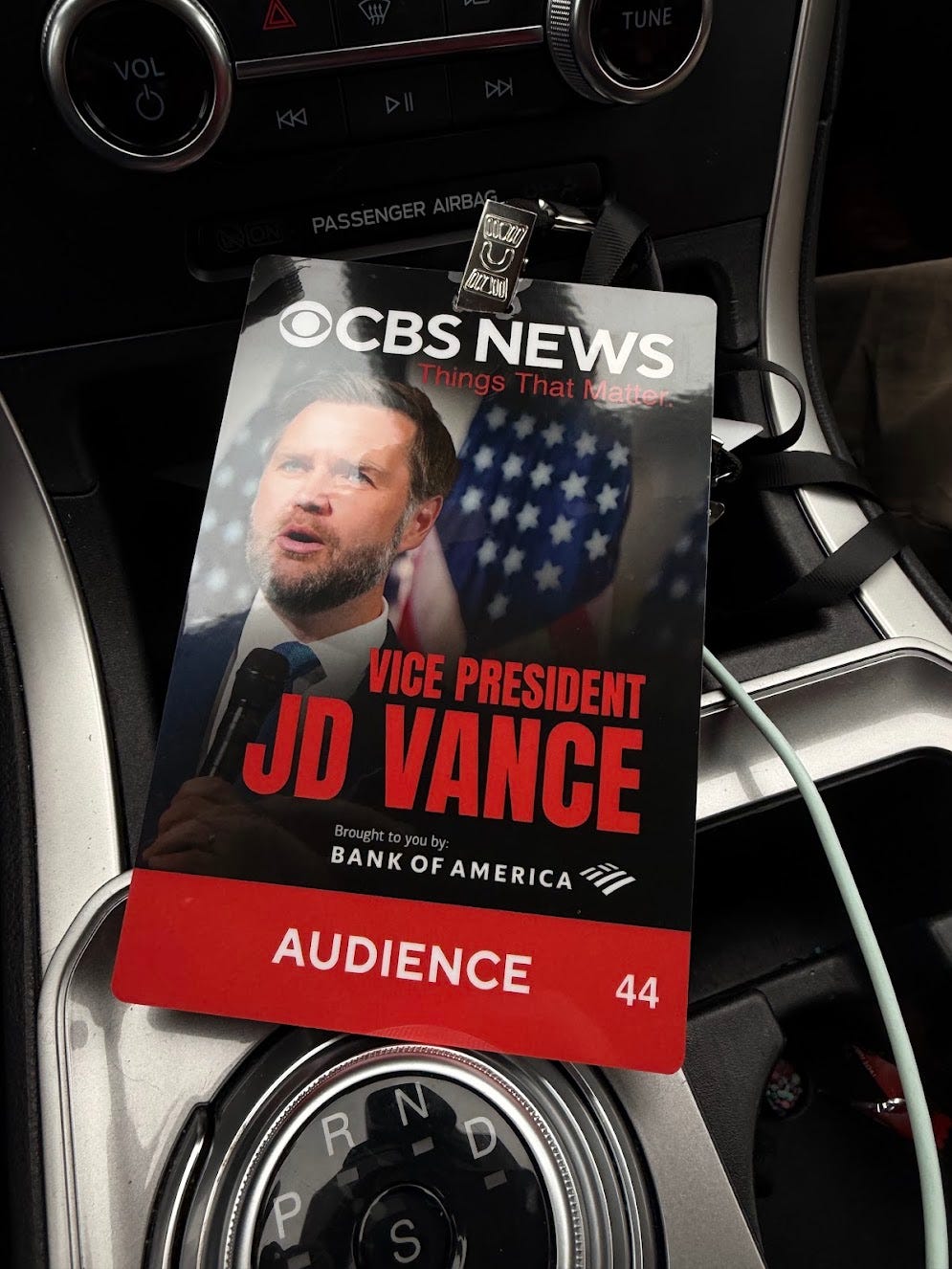
My question to the vice president concerns that responsibility. How do you listen to these young men and acknowledge their frustrations while challenging the harmful ideas some of them embrace? And what does that require when those same people are part of the political coalition whose support you need? I enjoyed seeing how Vance handled the situation. He argued that harmful ideas should be answered rather than silenced. He also spoke about the danger of condemning people because of their skin color, including young white men who believe they are being blamed for things they have not personally done. I appreciated his willingness to address that concern. We should be able to affirm the equal dignity of every person and recognize when our own language fails to honor it.
I have continued to think about the exchange, especially in light of the other questions people brought into the room. What struck me was how much fear was present beneath the concerns being expressed. I do not mean that as a criticism of the people asking. Many of those concerns carry real consequences for families and communities. People want to know whether they can build a life, provide for the people they love, and trust those who exercise authority over them. They want some assurance that the future will have a place for them. But sitting there, I began to think about a question we have recently considered in my Core Texts classes: What happens to our relationships when we become afraid of one another?
Thomas Hobbes has quite a bit to say about that. In Leviathan, Hobbes describes people who cannot be certain of one another’s intentions. Even a person who wants a peaceful life must consider what someone else might do. Under conditions of insecurity, mistrust can make striking first appear reasonable. Hobbes calls this “diffidence.” He identifies it alongside competition and glory as a cause of conflict: people fight for gain, safety, and reputation. Fear drives conflict, yet fear of death also moves people toward peace.
That is an uncomfortable observation because we tend to explain our own actions through our intentions and other people’s actions through their capacity to hurt us. I know why I want more protection. I am less certain why you do. What feels defensive to me can look threatening to you, and your response can confirm the very suspicion that prompted my behavior. We do not have to accept Hobbes’s entire account of human beings to recognize something familiar here. Consider how easily that pattern enters a conversation. Someone anticipates being dismissed and comes prepared to fight. The person receiving the question hears hostility and responds defensively. Each leaves with further evidence that the other cannot be trusted. There may have been something true and important to discuss, but neither person felt able to risk hearing it.
I wonder how often we are doing this to one another in our political life. If I become convinced that you intend to erase my future, your success will feel like my defeat. If I believe your community can flourish only at the expense of mine, compromise will begin to look like surrender. Even an invitation to listen may sound like a request to lower my defenses while you keep yours up. Hobbes’s political answer is a common authority powerful enough to make agreements dependable. People need more than promises when they have reason to fear betrayal. The sovereign provides security through the power to enforce those agreements. Fear does not disappear from this arrangement; fear of punishment helps sustain the peace. His argument takes seriously the need for protection and the difficulty of trusting without it.
There is a great deal there for a classroom to discuss. There was also something there for me to consider while sitting in a room with the vice president. People bring their fears to leaders because leaders possess some ability to act upon them. That is part of the purpose of political authority. A government should protect its people. A leader who dismisses every fear as ignorance or prejudice has failed to listen carefully enough. But fear also creates an opportunity for someone seeking influence. A frightened person wants to know who understands the danger. Someone who names it confidently can quickly gain a hearing. Identifying an enemy can provide an explanation for experiences that otherwise feel confusing or humiliating. And someone who promises protection can acquire a great deal of loyalty.
This places a serious responsibility upon the person being trusted. How carefully will he distinguish a real danger from an imagined one? Will he correct an accusation when the accusation is useful to him? Will he tell his supporters that something they believe is false, even when their belief helps keep them united behind him? Those questions extend well beyond elected office. They apply to commentators, pastors, teachers, and anyone else who has learned that people will listen when we speak about what frightens them. They also make leadership difficult in ways that are easier to describe from a distance than to navigate in person.
Being at the town hall gave me a greater appreciation for that difficulty. A leader hears concerns from people whose experiences and expectations can differ dramatically. An answer that reassures one person can alarm another. Words travel beyond the room, separated from the circumstances in which they were spoken. There are obligations, limitations, and consequences that an audience may never fully see. I do not think we should be careless about that burden. Political prudence matters. Timing matters. The ability to persuade matters. A person who loses every opportunity to be heard may also lose an opportunity to accomplish something good. Sometimes a difficult conversation requires patience, and sometimes a relationship must develop before a correction can be received. But I keep returning to the point at which those reasonable considerations become a way of avoiding the truth. How do we know when preserving our influence has begun to compromise the purpose for which we hoped to exercise it?
That question followed me into the pulpit this Sunday. In Mark 6, Herod gladly hears John the Baptist, even though John’s words perplex him. He recognizes John as righteous and holy and protects him. Yet at his birthday banquet, after making a public promise, Herod orders John’s death rather than refuse the request before his guests. His distress does not prevent him from issuing the command. He can recognize goodness and still fail to act on it. That is a frightening passage for anyone who teaches or preaches. Hearing the truth, appreciating the person speaking it, and feeling troubled by what it demands can all coexist with a refusal to obey it.

I am not equating a modern town hall with Herod’s banquet. The passage raises a question about human beings that extends across many settings, including my own. What happens when telling the truth threatens our standing among the people whose approval we value? Herod has the authority to issue an order, yet his guests’ expectations weigh on his decision. That is one of the things I find so unsettling about the story. Having power does not free a person from the fear of other people. It may give that fear a much greater reach. The person seeking protection is afraid. The person offering protection may also be afraid ... of losing support, of appearing weak, of being rejected, or of finding that the room has turned against him.
That is where my question about political leadership becomes a question about my own life. I know what it is to want to preserve a relationship so that a conversation can continue. As a father, I cannot approach every disagreement as though everything depends upon settling it immediately. As a professor, I want students to be able to express an unfinished thought without fearing that one awkward sentence will define them. As a minister, I want people to bring their doubts, resentments, and confusion into the light. That requires patience. It also requires honesty. If I am so concerned about keeping someone comfortable that I never challenge him, I have to ask whether I am serving his good or protecting my place in his life. If I continually postpone a difficult word because I fear his response, my silence may eventually become part of the problem.
There is a corresponding danger in speaking carelessly and then congratulating myself for being courageous. A person’s fear does not become less real because I have identified an error in his argument. Humiliation rarely makes a good beginning for instruction. Telling the truth faithfully requires attention to the person who must hear it. That is especially important with the young men I had in mind when I asked my question. Some have legitimate grievances. Some have accepted explanations that need to be challenged. Frequently, those things are tangled together. We have to be willing to listen closely enough to distinguish them.
We can tell a young man that his future matters while asking him to reconsider the story he has accepted about someone else. We can acknowledge that he has been treated unfairly without agreeing that an entire group is responsible for his difficulties. We can challenge contempt while giving him something more substantial to do with his life than defend himself against it. This is where I believe the language of purpose matters. Grievance can bring people together. Shared anger can give them a vocabulary, a community, and a reason to return tomorrow. But eventually a young man needs to know what he is being invited to become. What responsibility is his to accept? What work is worth doing? Whom might he serve? What good might require something of him?
Those questions cannot be answered adequately by a political coalition alone. They belong in homes, classrooms, congregations, workplaces, and friendships. They require people who are willing to remain present long enough to help someone grow. And they require us to examine the examples we are setting. We cannot reasonably ask young men to become less contemptuous while making contempt the ordinary language of our own public lives.
My sermon also considered the meal Jesus provides later in Mark 6. He sees the crowd, has compassion on them, teaches them, and feeds them. The disciples are drawn into the responsibility of caring for the people before them. The crowd’s needs become a call to service. I find that deeply hopeful. People can be gathered around something more sustaining than a common fear. They can learn to receive one another, accept responsibility, and discover that they have something to give.
For Christians, that hope ought to become visible in the life of the church. We should be communities where people can bring their fears and encounter patient attention, truthful speech, and meaningful work. A young man should be able to find people who care about what happens to him and who will expect something good of him. That does not relieve political leaders of their obligations. It reminds the rest of us that we have obligations too.
I am grateful that Ben and I went to Michigan. I appreciated the opportunity to ask my question and the vice president’s willingness to answer it. The experience gave me more to think about, including a greater awareness of how weighty these concerns become for those entrusted with leadership. But the weight of that responsibility makes the question of truth more pressing. There will always be reasons to wait, relationships to preserve, and consequences to consider. Wisdom requires that we take those things seriously. Faithfulness requires that we also ask what they are doing to our judgment.
Can we still correct the people whose approval we enjoy? Can we acknowledge a truth that makes our own position less comfortable? Can we help people face what frightens them without making their fear the basis of their loyalty to us? I hope our leaders can. I hope I can. What is our influence for, if we are never willing to risk losing it to tell the truth?
I pray that one day our divided country would find common ground. And be able to talk and have honest debate again. Blame shifting started back in the garden.
http://thenerdreich.com/unhumans-jd-vance-and-the-language-of-genocide