

A recording can play Taps.
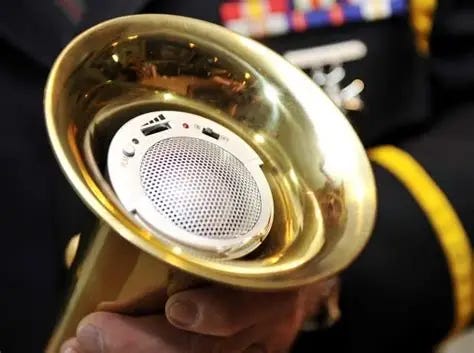
Technologically, we solved this problem a long time ago. If no bugler is available, we can press a button. Twenty-four familiar notes sound across the cemetery. They can be played at the right tempo, at the right volume, every single time. The recording does not get nervous. It does not miss a note. It does not get sick. It does not have somewhere else it needs to be. Yet, when people talk about it they say it doesn’t sound real. One person said, “It is too perfect….”
If our only goal is to produce the sound of Taps, the machine works remarkably well.
But what if producing the sound was never the whole point?
That question has been on my mind during our study of Prometheus Bound.
Most of us know at least the basic story of Prometheus. He defies Zeus and gives fire to humanity. For his rebellion, Zeus has him chained to a rock and subjected to terrible punishment.
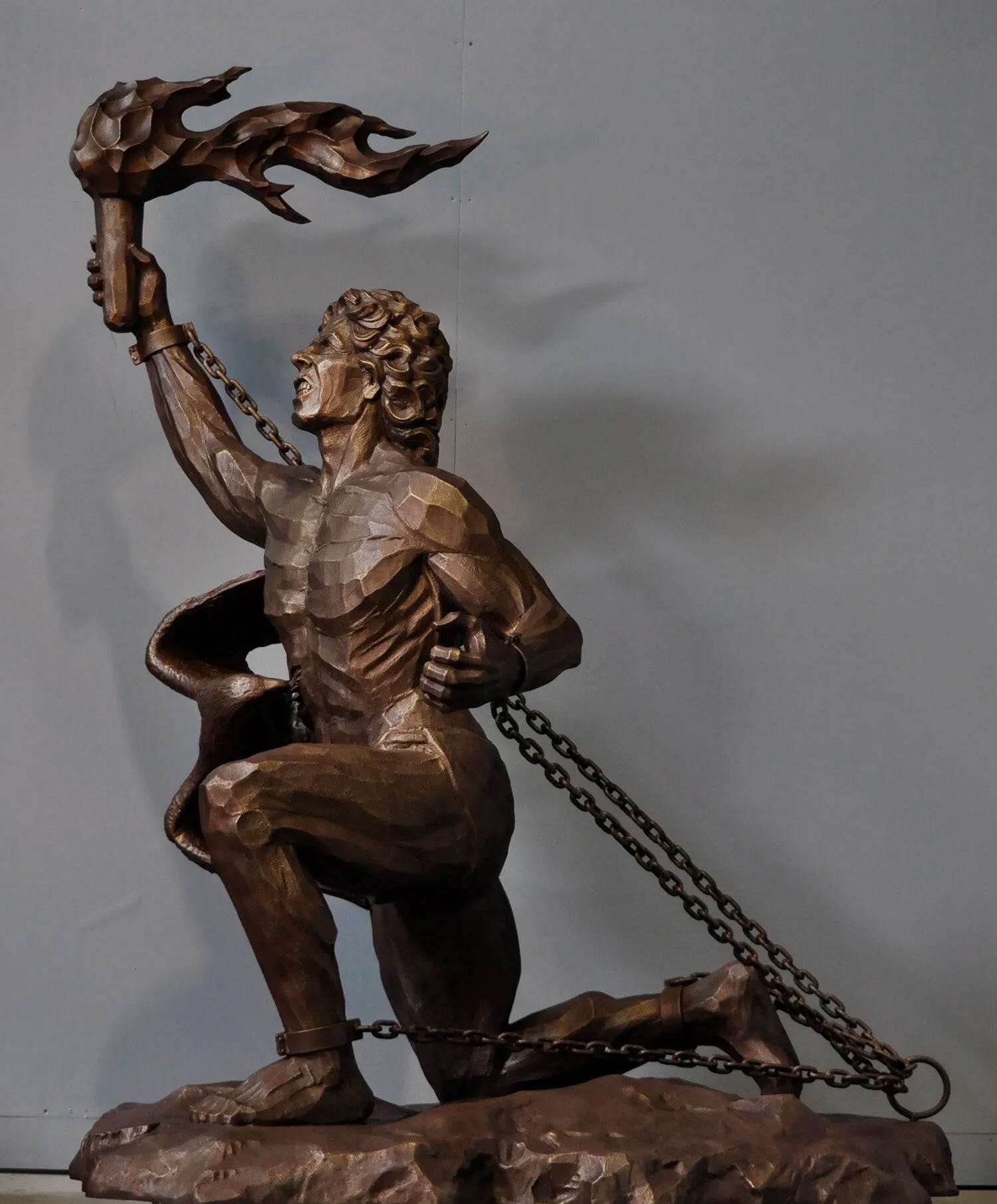
But fire in the story means much more than the ability to stay warm.
Prometheus describes fire as the thing that teaches humanity the arts and gives us the ability to create. Fire makes tools possible. It makes metalworking possible. It allows human beings to manipulate the natural world instead of simply being at its mercy.
In that sense, Prometheus gives humanity something much larger than fire.
He gives us technology.
And we have been running with that gift ever since.
We learned to cross oceans, build cities, generate electricity, cure diseases, split the atom, travel beyond the earth, communicate instantly across the planet, and now create machines capable of generating language, images, music, and ideas.
The amount of knowledge available to an ordinary person today would have been unimaginable for most of human history.
Prometheus would probably be impressed.
But Prometheus Bound also asks a question that is much less comfortable: does possessing knowledge mean that we possess wisdom?
Prometheus himself complicates the answer.
His name is associated with foresight, and he claims that he knew what was coming. His punishment was not an unforeseen consequence. He understood the cost of his rebellion and chose it anyway.
Yet Oceanus gives him one of the sharpest criticisms in the play. Prometheus, he says, is capable of teaching wisdom to everyone except himself.
That distinction has stuck with me.
It is possible to know a great deal and still not be wise.
Knowledge tells us what we can do.
Power gives us the ability to do it.
Wisdom asks whether we should.
That may be one of the defining problems of our age.
We tend to assume that technological advancement and human advancement are the same thing. If we can make something faster, easier, cheaper, or more efficient, we naturally assume that we have made it better.
Sometimes we have.
I am certainly not arguing that technology is evil. I am writing these words on a computer. I will publish them on the internet. Technology has saved lives, connected families, educated millions of people, and made possible things our ancestors could scarcely have imagined.
Fire is a gift.
But fire can warm a home or burn one down.
The ability to do something does not tell us what that ability is for.
And that brings me back to Taps.
A recording answers one question perfectly well:
Can we produce these twenty-four notes without a live bugler?
Of course we can.
But perhaps that is the wrong question.
The better question is:
What is Taps for?
If Taps is simply a piece of music that must be heard at a military funeral, then a recording is an efficient substitute for a musician.
But I don’t think Taps is merely sound.
Taps is an act.
A person stands before another person’s grave. He raises an instrument. He takes a breath. And for less than a minute, he offers something of himself to a veteran he may never have known.
There is a human being on both sides of those notes.
One has died.
The other has shown up.
That matters.
The recording can reproduce the notes.
It cannot reproduce the presence.
That distinction is one of the reasons behind my work with Real Taps for Real Heroes and why I have undertaken the 30 Days of Real Taps campaign. Yes, I want more musicians who are capable of playing Taps. But simply teaching people the correct notes is not enough.
I want another generation to understand why those notes are worth playing.
There is an enormous difference between passing down a skill and passing down a tradition.
A skill teaches you what to do.
A tradition teaches you why you are doing it.
In a strange way, that brings us right back to Prometheus.
We are extraordinarily good at passing down fire. Every generation inherits more technological power than the generation before it. We hand our children tools that would have looked like magic to their great-grandparents.
But are we equally good at handing down the wisdom necessary to use them?
That question extends far beyond military funerals.
Artificial intelligence can write a condolence message for me.
But there may still be times when love requires that I find the words myself.
A video call allows me to see someone thousands of miles away.
But there are still moments when I need to get in the car and show up.
A livestream can put a church service on my television.
But watching a community and belonging to one are not necessarily the same thing.
A recording can play Taps.
But hearing Taps and having someone play Taps for you may not be the same thing either.
Technology is very good at asking, “How can we accomplish this?”
Wisdom asks the question technology cannot answer:
“What are we trying to preserve?”
The Bible treats wisdom this way. Wisdom is not presented merely as having more information. In fact, Scripture repeatedly warns us that intelligence, knowledge, wealth, and power can all exist without wisdom.
“The fear of the Lord is the beginning of wisdom,” Proverbs tells us.
That is a very different understanding of wisdom from the one our technological culture often adopts. Biblical wisdom begins with recognizing that we are not God. We do not create the purpose of things simply because we have acquired the power to change them.
Sometimes wisdom means inventing something new.
Sometimes wisdom means recognizing that an old way can be improved.
But sometimes wisdom means looking at something we are perfectly capable of replacing and deciding that we should preserve it anyway.
Not because we lack the technology.
Because we understand the meaning.
Perhaps that is one lesson Prometheus still has for us after more than two thousand years.
We have the fire.
We have become very good at using it.
The question is whether our wisdom has kept pace with our power.
That is part of what I hope to accomplish with 30 Days of Real Taps. Of course I want to find and train musicians who are willing to serve. But I also want to preserve something that cannot be stored in an audio file.
The willingness of one human being to stand in front of another human being’s grave and say, through twenty-four notes:
You were here.
Your service mattered.
And someone cared enough to show up.
A machine can play the notes.
Wisdom reminds us why a person still should.