
Obsession
When a Wish Exposes Real Evil

“Is the new Obsession film any good?’ ‘Well, it is definitely real….”
I saw Curry Barker’s 2026 horror film with a friend and my 21-year-old son. It is not “good” if you mean beautiful, hopeful, or uplifting. It does not lift the spirit or point clearly toward redemption or restoration. What it does do is show something real... the destructive power of obsession and the evil that follows when we try to force love on our own terms.
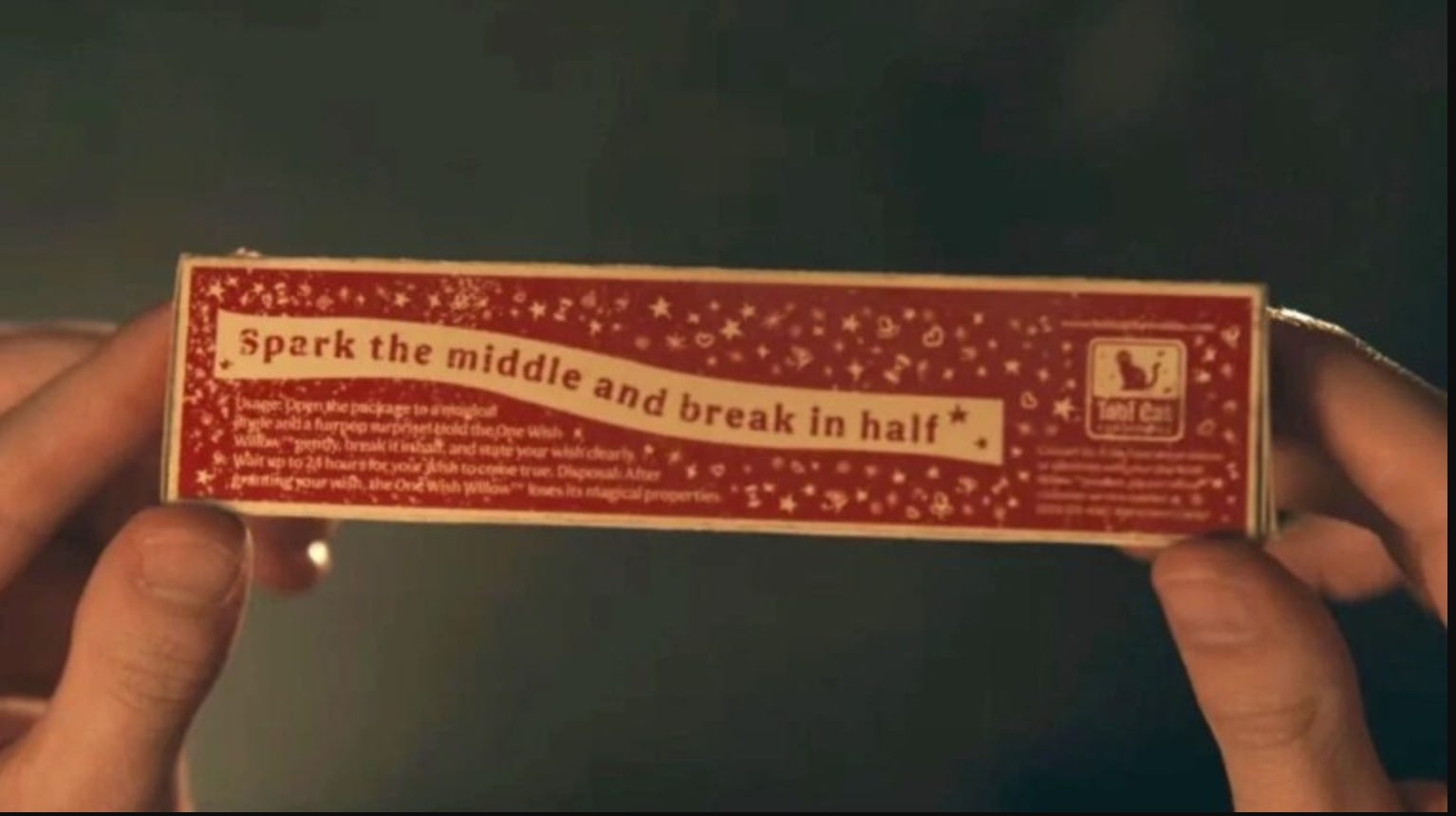
The plot echoes the W.W. Jacobs horror story The Monkey’s Paw... a seemingly simple wish granted with nightmarish consequences. Bear, a music store employee, buys a novelty “One Wish Willow” and wishes for his coworker and crush, Nikki, to love him unconditionally and forever. The wish appears to succeed at first. Then everything spirals into horror... coercion, loss of autonomy, violence, and broken lives all around them. It is a classic cautionary tale about getting exactly what you ask for, only to discover the terrible cost.

The story also reminded me of Edgar Allan Poe’s psychological tales... the descent into obsession, guilt, and madness, with an oppressive atmosphere that lingers. Barker’s direction builds suspense in the style of Hitchcock... long stretches of tension, careful framing, and a growing sense of dread that makes ordinary moments feel threatening. Even without relying on constant jumps, the film keeps you uneasy as the consequences of Bear’s wish unfold.
This feels real in the way some effective 70s-era horror did... grounded in recognizable human failure even when supernatural elements enter. Bear’s “harmless” wish reveals deeper issues... treating another person as a means to fulfill his longing rather than respecting her as made in God’s image. It is a vivid picture of privation... evil as the twisting and absence of good. Love, rightly ordered, gives and respects freedom. This version consumes and controls.

Lewis warned against this kind of disordered love. Augustine saw the restless heart that will not rest in God. McGilchrist’s insights on attention remind us how easily we reduce persons to our narrow maps and miss the living reality before us. The movie dramatizes that reduction with disturbing clarity. Bear’s passivity and Nikki’s forced obsession destroy relationships, friendships, and selves. It is a horror of the human heart left to itself.
The film’s value lies in this honesty. Popular stories like this can sharpen our ability to see present patterns... in relationships, culture, technology, or the quiet ways we try to control outcomes. It shows the cost of idolatry... wanting a good thing (love, connection) in the wrong way, at the wrong time, by the wrong power.
We do not need every story to comfort us. Some, like this one, warn us. They push us back to Scripture, where love is patient, kind, and does not insist on its own way. They highlight our need for grace that truly frees and restores rather than binds.